Electronic ink is no longer a technology associated exclusively with e-readers. The same paper-like displays that made digital books comfortable to read are increasingly appearing in supermarkets, warehouses, offices, hotels, and transportation facilities. Businesses are discovering that many information screens do not need bright backlighting, video playback, or constant animation. They simply need to display accurate information and update it when necessary. Electronic paper offers an alternative to traditional LCD screens and printed labels, combining digital flexibility with extremely low display power consumption. Its growing commercial use reflects a broader shift toward technologies that reduce routine maintenance, simplify information management, and help organizations replace repetitive manual processes.
The main advantage of electronic ink comes from its unusual operating principle. Unlike conventional LCD displays, which require continuous electrical power to maintain a visible image, electrophoretic screens use electrically charged pigment particles to create text and graphics. Once the particles have moved into position, the image remains visible without additional display power. This property, known as bistability, makes electronic paper particularly suitable for information that changes occasionally rather than continuously. The technology also reflects surrounding light instead of relying on a conventional illuminated screen, giving it an appearance similar to printed paper. However, a complete electronic label still uses electricity for its processor, wireless communication, and other components. Actual battery life therefore depends on the display size, communication method, temperature, and frequency of updates.
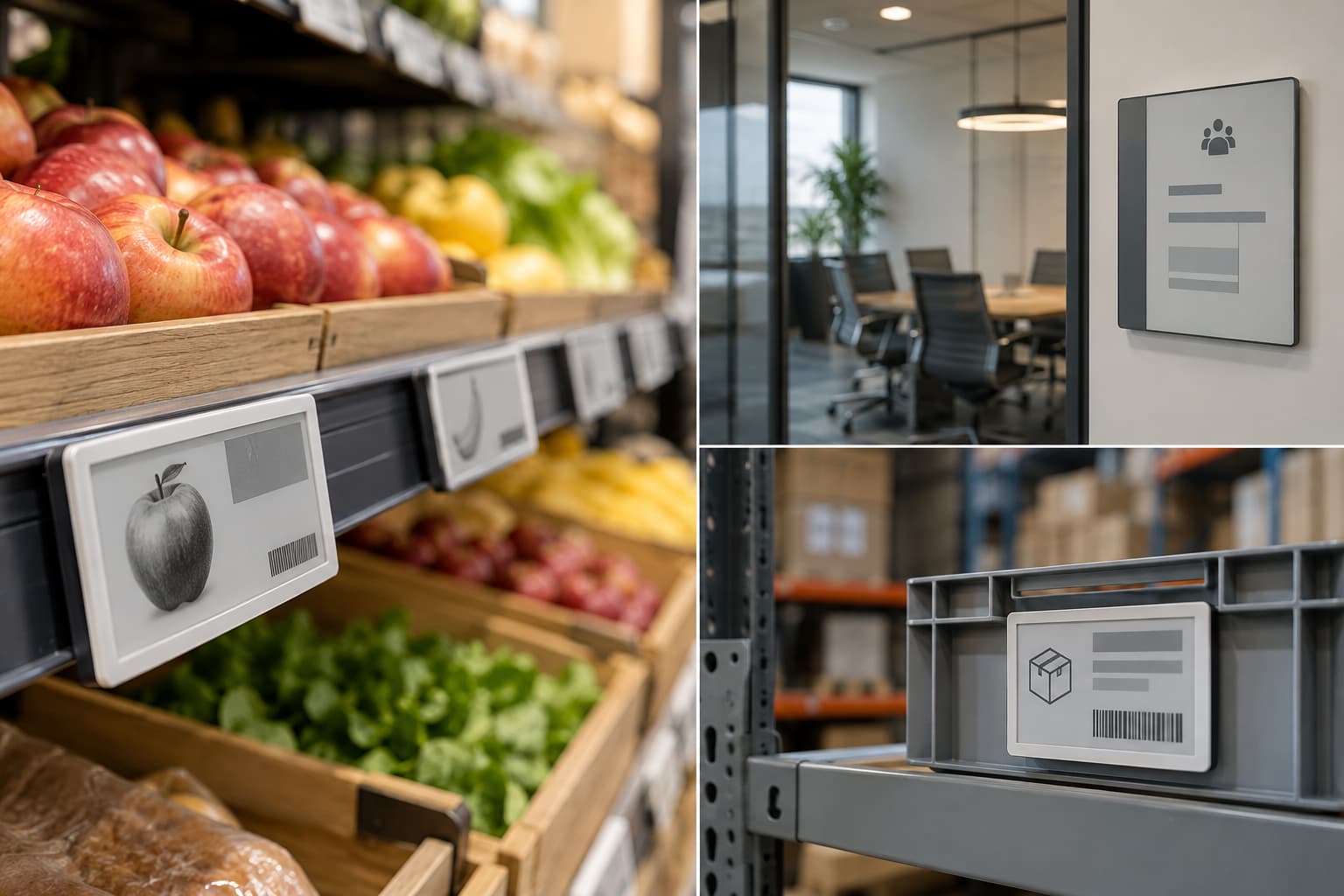
Retail has become one of the most established commercial applications. Electronic shelf labels allow supermarkets and other stores to replace printed price tags with small digital displays connected to a central management system. Employees no longer need to walk through every aisle replacing paper labels whenever prices or promotions change. Instead, authorized updates can be distributed wirelessly to hundreds or thousands of devices. This is especially valuable for retailers operating several locations or frequently adjusting promotional campaigns. Some systems can also display product descriptions, stock information, and promotional indicators. E Ink reports that compatible shelf-label implementations can achieve battery lifetimes of several years, with certain configurations reaching five years. The practical advantage extends beyond labor savings. Centralized updates can reduce inconsistencies between shelf prices and checkout systems, although successful synchronization still depends on reliable software integration and operational controls.
Warehouses and logistics facilities offer another promising environment for electronic paper. Traditional printed labels become inconvenient when storage locations, inventory assignments, and order priorities change frequently. Electronic labels mounted on shelves, containers, or reusable transport equipment can display updated product identifiers, quantities, and handling instructions without repeated printing. A warehouse management system can send new information when goods move between locations, helping employees identify the correct items during picking and replenishment. Electronic paper is particularly useful where information must remain visible for extended periods without access to permanent electrical wiring. However, industrial environments introduce additional requirements. Devices may need protective housings, dependable wireless coverage, and specialized displays capable of operating in cold storage areas. The suitability of electronic ink depends on the physical conditions and update frequency of each facility.
Office environments are also experimenting with paper-like digital displays. Meeting rooms can use small electronic signs to show reservations, availability, and scheduled activities. Employees immediately see whether a room is occupied or available without checking a separate application. Similar displays can identify desks, communicate workplace announcements, or provide navigation information inside large buildings. Because the displayed image remains visible without constant screen power, battery-operated signs can often be installed without complicated electrical work. This flexibility is useful in renovated offices where adding wiring would be expensive or disruptive. Hotels and conference centers can apply the same approach to room identification, event schedules, and directional information. For these applications, electronic paper works best when updates occur periodically and information needs to remain readable throughout the day.
Larger electronic paper displays are expanding the technology’s role in commercial signage. In May 2026, LG announced a 32-inch electronic paper display for business environments, designed for applications such as retail promotions, hospitality information, and corporate communications. The product illustrates the movement from small electronic labels toward larger digital surfaces intended to replace frequently updated printed posters. Unlike conventional digital advertising screens, electronic paper does not depend on continuous animation to attract attention. Its advantage lies in presenting information that looks closer to a physical sign while remaining remotely editable. Restaurants could update menu boards, stores could change promotional materials, and office buildings could revise visitor information without printing replacements. Nevertheless, electronic ink is unlikely to replace every commercial screen. Video advertising, highly animated interfaces, and applications requiring rapid interaction remain better suited to conventional display technologies.
The financial case for electronic paper depends on more than electricity savings. Businesses must account for device prices, installation, wireless infrastructure, software licensing, integration, battery replacement, and eventual hardware disposal. A small shop with stable prices may find traditional paper labels more economical, while a supermarket changing thousands of prices every week may recover its investment through reduced manual work. The same distinction applies to offices and warehouses. A printed notice that changes once a year offers little reason to install electronic hardware, but hundreds of signs requiring frequent coordinated updates represent a different calculation. Organizations should estimate how much staff time is currently spent printing, distributing, replacing, and correcting physical information. They should also consider whether centralized updates will reduce operational mistakes. Pilot installations can reveal actual savings before a company commits to deployment across multiple locations.
Electronic paper still has technical limitations that business buyers should understand. Many displays refresh more slowly than conventional monitors, and certain update modes can produce visible flashing or temporary image artifacts. Repeated partial refreshes may cause ghosting, where faint traces of previous content remain until the screen performs a more complete refresh. Color electronic paper has improved considerably, but its brightness, saturation, and refresh characteristics generally differ from those of LCD or OLED displays. Temperature can also affect performance, particularly in refrigerated environments or outdoor installations. Specialized panels address some of these challenges, although they may increase costs. Wireless communication creates additional operational concerns, including device authentication, update reliability, and software maintenance. Businesses need a management system that can identify failed updates and prevent outdated information from remaining unnoticed on individual screens.
The future of electronic ink in digital business is likely to depend on selecting applications where its particular strengths matter most. A display that rarely changes but must remain visible around the clock is an excellent candidate. A screen designed for continuous animation is not. As larger panels, color technologies, and centralized management platforms improve, electronic paper may become increasingly common in places where businesses currently rely on printed signs or unnecessarily power-hungry monitors. Its real contribution is not simply replacing paper with electronics. It is making physical information easier to manage, update, and connect with existing digital systems. For retailers, logistics operators, office managers, and hospitality businesses, electronic ink offers a practical reminder that the most useful display technology is not always the brightest or fastest, but the one that fits the job.